
Martin Thou
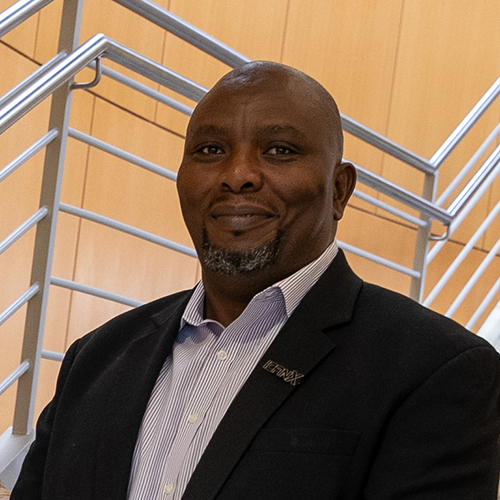
Bio
Our group is interested in frugal science/innovation, the ability to minimize cost and complexity while providing efficient solutions to better human conditions. We are, by necessity, an interdisciplinary physical-organic/materials research group interested in engineering soft matter and understanding surfaces and interfaces at all size scales. Our research focuses on the development of a generalized framework for engineering structures and ultimately functional devices via self-assembly and/or stacking of molecules, films, or layers of materials, to introduce new function(s) or utility.
Education
Postdoctorate Chemistry and Materials Science Harvard University 2012
Ph.D. Chemistry University of Iowa 2008
Master of Science Chemistry Simon Fraser University 2004
Master of Science Chemistry Kenyatta University 2002
Bachelor of Science Applied Mathematics and Chemistry Kenyatta University 1999
Area(s) of Expertise
Functional soft matter and surface/interface thermodynamics (SMMT) to design metastable materials for advanced manufacturing and technology applications
Publications
- Avoiding the Kauzmann Paradox via Interface-Driven Divergence in States , ANGEWANDTE CHEMIE-INTERNATIONAL EDITION (2025)
- Industry-academia partnership in building materials science capacity in Africa , MRS COMMUNICATIONS (2025)
- Influence of interface asymmetry on phase partitioning in metal alloys , MATTER (2025)
- Kauzmann Paradox, Supercooling, and Finding Order in Chaos , Angewandte Chemie (2025)
- Kauzmann Paradox, Supercooling, and Finding Order in Chaos , ANGEWANDTE CHEMIE-INTERNATIONAL EDITION (2025)
- Timed Physical Password or Authentication Keys , ACS APPLIED MATERIALS & INTERFACES (2025)
- Atomic Reconstruction of Au Thin Films through Interfacial Strains , NANO LETTERS (2024)
- Cognitive Diversity for Creativity and Inclusive Growth , Angewandte Chemie (2024)
- Cognitive Diversity for Creativity and Inclusive Growth , ANGEWANDTE CHEMIE-INTERNATIONAL EDITION (2024)
- Correcting Edge Defects in Self-Assembled Monolayers through Thermal Annealing , CHEMPHYSCHEM (2024)
Grants
Our group is interested in frugal science/innovation, the ability to minimize cost and complexity while providing efficient solutions to better human conditions. We are, by necessity, an interdisciplinary physical-organic/materials research group interested in engineering soft matter and understanding surfaces and interfaces at all size scales. Our research focuses on the development of a generalized framework for engineering structures and ultimately functional devices via self-assembly and/or stacking of molecules, films, or layers of materials, to introduce new function(s) or utility.
Recycling at Point of Disposal via Energy Landscape Engineering
The objective of this project is to achieve RPOD by demonstrating the role of multi-prong stimuli on interface structure/stability (and associated metastability), that enables non-equilibrium relaxation, leading to de-mixing.