Thermodynamics of the Mind and Efficient Problem Solving
Advances in thermodynamics have led to major technological innovations, some of which we rarely associate with it. Elegance of thermodynamics rests in emergent simplicity, especially in complex systems. Out of the four laws, the second law presents a challenge when interpreted in layman’s language i.e. the world tends towards chaos. To a layman, this is a paradox given our need to minimize chaos by maintaining order (socially and physically). Our need for order is not limited to mundane tasks like cleaning or complex tasks like urban planning but extends to cognitive tasks like scientific problem solving. Recognizing this challenge, efforts like the Center for Complex Particle systems (COMPASS) in America have emerged to bring coherence to rather chaotic, hence poorly understood many-body physical systems. In Africa, however, limited resources force scientists to think ‘outside the box’ to remain globally relevant while solving difficult challenges. Despite the apparent differences between complex particles (many) and resource-limited (less) settings, every question thermodynamically revolves around entropy. Given the asymmetry in information in these settings, we can infer that Prigogine’s principle of minimum entropy production must be violated to overcome the dissonance. Scientifically therefore, entropy must increase if one is to shift to a steady (comfortable) state. In essence, to address large challenges we need to; i) create a far-from-equilibrium state in which the steady state (status quo) is often challenged, ii) embrace the second law of thermodynamics and endeavor to maximize entropy, and iii) be willing to pay the energy cost associated with maximizing entropy production, a condition necessary to escape an apparent steady state.
Outreach and Engagement
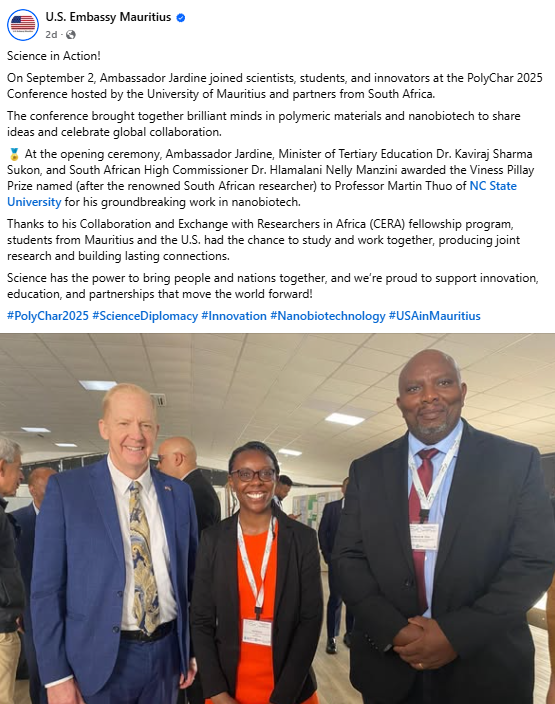
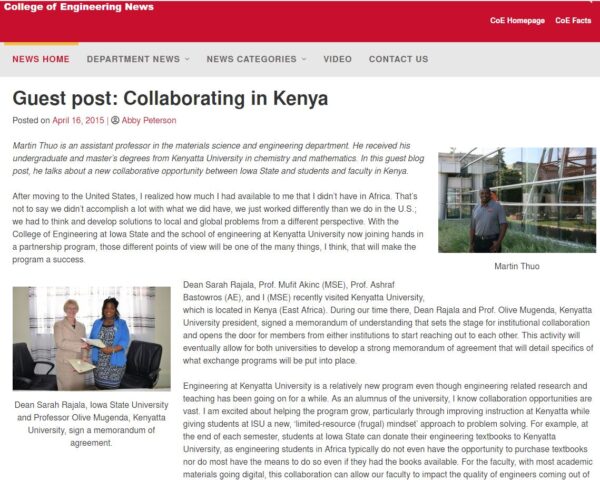
Besides research and innovation, the mission of a land grant university is to translate/extend findings and inventions to the community. Here we highlight outreach and engagement with communities local and global (some prior to NC State) with an emphasis on the Collaboration and Exchange with Researchers in Africa (CERA) under the NSF-STC Center for Complex particle systems (COMPASS).
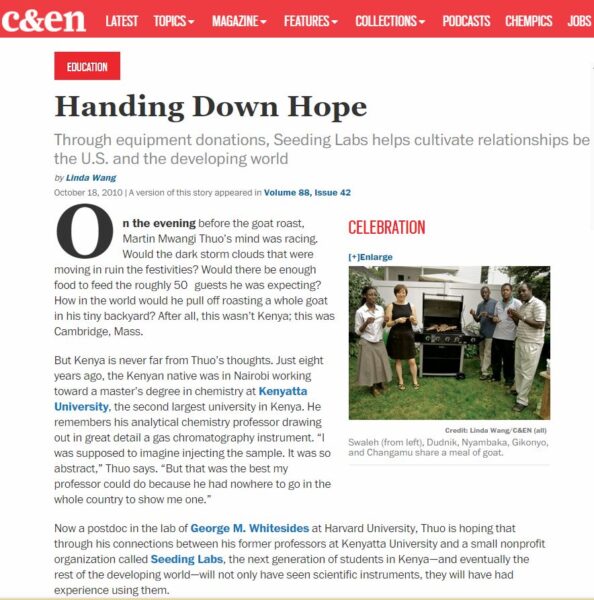
History: Handing down hope – faculty internships through seeding labs at Novartis!